
7 Deadly Sins vs. 7 Heavenly Virtues: Complete Guide & Chart
Complete list, opposite pairs, modern everyday examples, and how the 7 Heavenly Virtues compare with the Cardinal Virtues
What Are the 7 Deadly Sins and the 7 Heavenly Virtues?
The 7 Deadly Sins (also called the capital vices) and the 7 Heavenly Virtues (often called the seven contrary virtues) form a 14-trait framework mapping classic human extremes against the stabilizing habits that balance them. Originating in early Christian monastic ethics—especially Evagrius Ponticus, Pope Gregory I, and later systematized by Thomas Aquinas—the pairing endures today because every vice describes a recognizable psychological reflex, while every virtue describes a practical antidote anyone can train regardless of background.
| # | Deadly Sin (Vice) | Core Impulse | Opposite Heavenly Virtue | Stabilizing Habit |
|---|---|---|---|---|
| 1 | Pride (Superbia) | Seeking superiority, status, and flawless image | Humility (Humilitas) | Accurate self-regard and openness to correction |
| 2 | Greed (Avaritia) | Hoarding wealth, leverage, or credit beyond need | Charity (Caritas) | Generous giving of time, resources, and goodwill |
| 3 | Wrath (Ira) | Uncontrolled anger, vengeance, or sharp hostility | Patience (Patientia) | Calm restraint and measured judgment under friction |
| 4 | Envy (Invidia) | Resenting others’ good fortune or achievements | Kindness (Humanitas) | Warm empathy and genuine joy in others’ wins |
| 5 | Lust (Luxuria) | Ungoverned craving for romantic or sensory thrill | Chastity (Castitas) | Focused self-command, loyalty, and respect |
| 6 | Gluttony (Gula) | Overconsumption to numb discomfort or chase comfort | Temperance (Temperantia) | Knowing "enough" across habits, screens, and appetite |
| 7 | Sloth (Acedia) | Avoiding meaningful effort and drifting into apathy | Diligence (Industria) | Consistent daily follow-through on what matters |
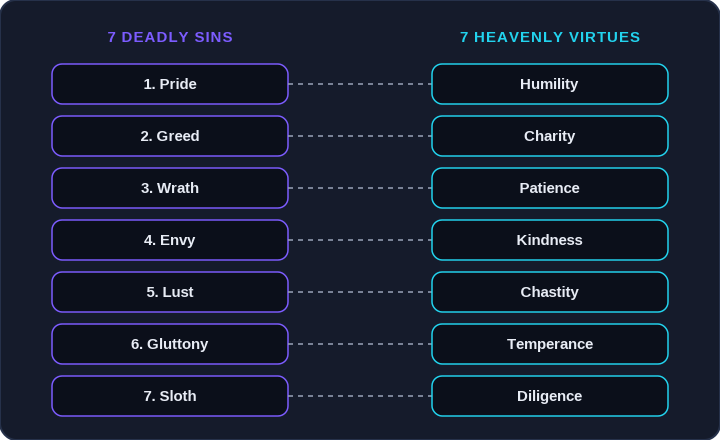
If you want to see where you personally sit across all 14 dimensions, start with the 3-minute 7 Deadly Sins Test and follow it with the 7 Virtues Test to unlock your automatic 14-trait Light & Shadow Map.
Everyday Examples of the 7 Virtues and 7 Vices
Historical labels can sound abstract until you translate them into ordinary workdays, relationships, and digital habits. Here is how all seven opposing pairs show up in real life:
1. Pride vs. Humility
- Pride in action: Defending a flawed decision in a meeting just to avoid looking mistaken, or secretly keeping tally of who owes you praise.
- Humility in action: Saying "Good catch—your approach is cleaner" without losing confidence, and spotlighting teammates who handled quiet foundational work.
2. Greed vs. Charity
- Greed in action: Gatekeeping helpful contacts, underpaying collaborators despite healthy margins, or feeling anxious whenever someone else gains leverage.
- Charity in action: Making an introduction that helps a colleague land a role, tipping fairly, or sharing hard-won playbooks without demanding an immediate return.
3. Wrath vs. Patience
- Wrath in action: Firing off a sarcastic email seconds after reading a clumsy request, or stewing over a minor traffic delay for the rest of the morning.
- Patience in action: Stepping away for ten minutes before answering a tense message so your response solves the underlying problem rather than escalating ego.
4. Envy vs. Kindness
- Envy in action: Scrolling past a friend’s promotion with a knot in your stomach, or minimizing someone’s success by whispering that they simply got lucky.
- Kindness in action: Sending a sincere note of congratulations and asking what they learned along the way—turning comparison into connection.
5. Lust vs. Chastity
- Lust in action: Flirting with boundary-crossing thrills for validation, or letting an intense infatuation derail reliable commitments and close friendships.
- Chastity in action: Honoring clear personal standards, treating attraction with respect rather than entitlement, and investing energy into steady, trustworthy bonds.
6. Gluttony vs. Temperance
- Gluttony in action: Continuing to snack, doom-scroll, or impulse-buy past midnight long after enjoyment faded into fatigue.
- Temperance in action: Savoring a favorite meal or show consciously and closing the tab or setting down the fork while energy still feels clear.
7. Sloth vs. Diligence
- Sloth in action: Rearranging low-stakes chores all week while avoiding the one high-impact project or tough conversation that actually moves life forward.
- Diligence in action: Protecting one focused 30-minute block each morning to chip away at meaningful work before distractions pile up.
Heavenly Virtues vs. Cardinal and Theological Virtues
People searching for the 7 virtues often encounter two slightly different classical lists—and understanding the distinction clears up a common source of confusion:
- The 7 Contrary (Heavenly) Virtues: Humility, Charity, Patience, Kindness, Chastity, Temperance, and Diligence. This list was explicitly structured as a direct one-to-one mirror against the 7 Deadly Sins, which is why modern quizzes—including our 7 Virtues Test—use these seven dimensions.
- The 4 Cardinal Virtues + 3 Theological Virtues: Classical Greek and scholastic philosophy also grouped seven virtues by combining the 4 Cardinal Virtues (Prudence, Justice, Fortitude, Temperance—derived from Plato and Aristotle) with the 3 Theological Virtues (Faith, Hope, Charity). Notice that Temperance and Charity appear in both traditions, while the remaining virtues emphasize wisdom, fairness, courage, and hope alongside everyday behavioral balance.
How to Use Both Lists for Practical Self-Reflection
Human personality rarely splits cleanly into "good" and "bad." A high score on Pride often coexists with impressive Diligence; intense Wrath sometimes hides fierce loyalty to fairness. Treating these 14 traits as adjustable dials rather than moral verdicts lets you diagnose friction quickly:
- Map your shadow first: Take the 7 Deadly Sins Test to spot which two impulses spike highest under stress.
- Measure your natural brakes: Take the 7 Virtues Test to discover which virtues already protect your balance—and which counter-virtue needs deliberate practice.
- Compare perspectives: Share a private link via My7Sins Compare with a close friend or partner; outside contrast frequently highlights blind spots you would never notice alone.
Want to inspect how our 28-question Likert scales normalize scores without inflating positive answers? Read our Scoring Methodology.